The mission of the Dance Exchange is
to create dances that arise from asking: Who gets to dance? Where is the
dance happening? What is it about? Why does it matter?
Dance Exchange is an intergenerational company
of artists that creates dance and engages people in making art. We serve
as an incubator for creative research, bringing ideas to action through
collaborations that range from experts in the field of dance to unexpected
movers and makers. Through these exchanges we stretch the boundaries
between the studio, stage, and other environments to make dances that are
rooted in the particularity of people and place. We recognize
the body and movement as an essential resource to understand and investigate
across disciplines. Through local, national, international, and online
projects we gather and create community to contribute to a healthy and more
sustainable environment.
About Dance Exchange Dance Exchange breaks boundaries between stage and audience, theater and community, movement and language, tradition and the unexplored. Founded in 1976 by Liz Lerman and now under the artistic direction of Cassie Meador, Dance Exchange stretches the range of contemporary dance through explosive dancing, personal stories, humor, and a company of performers whose ages span six decades. The work consists of concerts, interactive performances, community residencies, and professional training in community-based dance. Dance Exchange employs a collaborative approach to dance making and administration. Recent and current projects include explorations of coal mining, genetic research, human rights, particle physics, ecology, land use, and rest in a hyper-driven society.
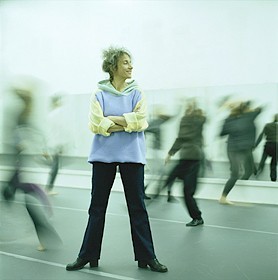 |
What I was imagining somehow for dance- that somehow we could use our extensive skills and tools to build, or rediscover, or create a community, a sense of community, an awareness of a collective existence. ~Liz Lerman, Hiking the Horizontal, p. 33 |
Small Dance, Big Ideas
Choreographed by Liz Lerman, Commissioned by Harvard Law School and Facing History & Ourselves
Commemorating the 60th Anniversary of the Nuremberg Trials, the piece explored issues of genocide and the body
The Cyclical Research Process of Choreography:
In our best choreographic experience, the stories forced the structure, the
structure supported the investigation, and all were subject to subtle shifts,
variations, and wholly new directions when things failed. And things failed all
the time. We just plowed through again and again, sometimes never finding the
right translation and sometimes learning something new, finding a fresh
metaphor or letting go of a precious favorite to make room for the unexplored.
~ Liz Lerman, Hiking the Horizontal, p. 74
Action Research: Lerman worked with older generations, using dance as a means of improving quality of life through creative and physical activity. In the chapter, Who gets to dance?, Lerman describes her earliest work with older generations in 1975 at the Roosevelt for Senior Citizens in Washington, D.C., In reminiscing on her experience, Lerman states, “from an artistic point of view, we could change people’s lives, and from a community point of view, we could change how people interacted. And the evidence kept coming that from a personal point of view we were changing people’s physical beings. Every week I got reports from women who could once again zip the backs of their dresses or from men who could get in and out of the bathtub again” (47). | 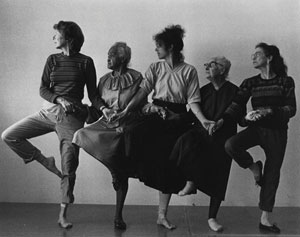 Above, Liz Lerman (center) dances with ladies from the Roosevelt for Senior Citizens in the famous 1982 photo Swan Lake. |
Liz Lerman Dance Exchange at St. John's On The Lake 2010:
| Lerman drew from her experiences as a choreographer to create the Dance Exchange Toolbox, a resource for teaching artists. Below is her basic methodology:  Foundations Foundations |
|
3. Let meaning be discovered. 13. Practice active belonging. A fabulous resource for arts educators interested in original devising around dance with groups of any age, size, ability-level or experience: http://danceexchange.org/toolbox/foundations.html |
